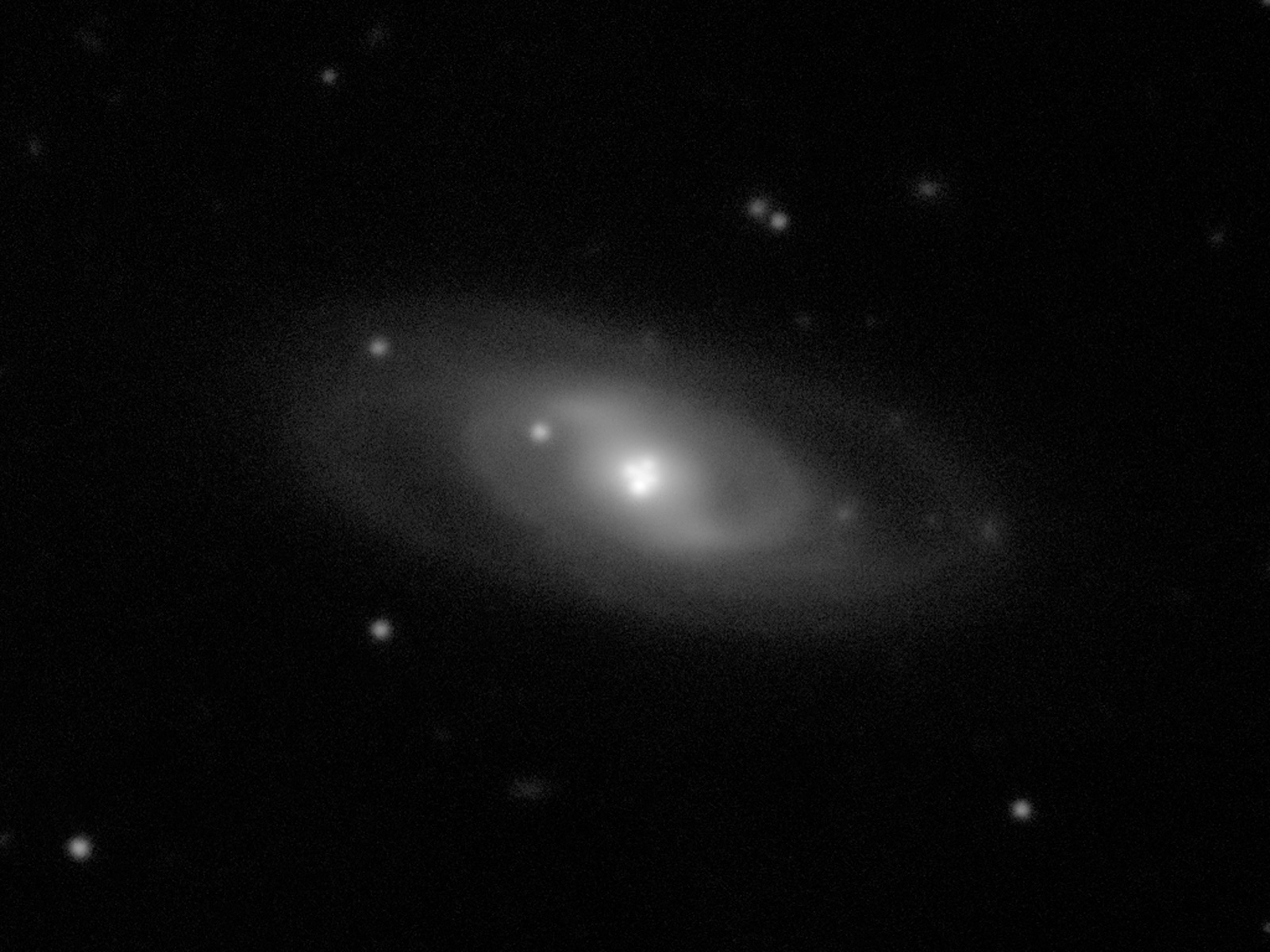
The galaxy’s visual signature is defined by tightly wound spiral arms, glowing with the warm light of aging stars and punctuated by clusters of blue and pink stellar nurseries. While its fan-like appearance suggests stability, M88 is a member of the Virgo Cluster, a massive collection of over a thousand galaxies currently locked in a complex orbital dance. Astronomers project that within 200 to 300 million years, M88 will make its closest approach to the cluster’s central elliptical giant, Messier 87.
This trajectory forces M88 through the dense intergalactic medium, triggering a phenomenon known as ram pressure stripping. As the galaxy moves, the surrounding gas acts like a stiff wind, sweeping away its internal reservoir of cold gas. Evidence of this impact is already visible: the galaxy’s gas disk is compressed at the leading edge, and outer regions show a distinct lack of the raw material necessary for new star formation. These environmental pressures are fundamentally rewriting the galaxy's evolutionary path, signaling a future where its ability to spawn new stars will be significantly diminished.




Comments (0)
No comments yet. Be the first!